Monday, March 23, 2026

Teach Out Proposal: Revisiting a Flawed Report

 Step 1: Choose a Text

While I intend to use a fair number of the concepts and topics that we've covered in class, I intend to use The Silenced Dialogue by Lisa Delpitt and One Room Schoolhouse - Chapter 2 by Sal Khan as my main two texts. I think both of these texts challenge conventional ideas of education by examining how our educational system is largely designed not as an effective education tool, but rather a system with more complex and less-lofty goals. 

Step 2: Choose an Audience

In 2023 and 2024, I was the Mayoral Designee on a Legislative Commission created to provide recommendations on labor-management standards for the Providence Public School District. The robustly named "Special Legislative Commission to Review and Provide Recommendations for Professional and Labor-Managment Standards that Provide School-based Flexibility and Accountability for Employees of Providence Public Schools" never actually issued our final report, as the two members of the commission representing the two teacher unions quit in protest when the final draft of the report was written. That report can be found here. 

For my teach-out, I intend to hold several meetings. I intend to meet separately with: (1) former Commission Chair Senator Samuel Zurier; (2) My former boss and replacement at the Providence Mayor's Office, and (3) hopefully the members of the Unions, though I think that is my most uncertain meeting. 

Step 3: Choose a Format

I think for a structure I will use 1:1 or 1:2/3 meetings that I record. What I would like to do is talk through the top-level recommendations of the report, and how I now see this report through a new lens as a teacher. I want to use the Khan and Delpitt texts to really unpack with Senator Zurier and Chief of Policy Sheila Dormody some of the inherent and flawed assumptions we make about what needs to stay the same in education, and make an appeal for boldness when we think about education policy. I also want to bring some of my personal experiences into the framework for talking specifically about student behaviors and management within a structure that (as Kahn describes) is not designed with their well-being in mind. I would like to emerge from these meetings with recorded audio, and some interesting notes or questions raised by these two phenomenally intelligent policy minds. 


Sunday, March 15, 2026

Creating Helpful Guidelines or Passing the Buck?

Introduction 

On May 1, 2019, then-Mayor Jorge Elorza signed a "Plastic Bag Ban" into effect in the city of Providence. This ordinance unequivocally banned businesses from using single-use plastic bags to contain the items purchased by their customers. And yet, five years later, I had to stop the deli just two blocks away from Providence City Hall from putting my Friday-Treat sandwich, iced tea, chips, second bag of chips, and cookie (I'm a weak man) into a plastic bag. Huh? What? Why? I remember walking down the street with food flowing out of every pocket, a living example of the distance between "policy", "execution of policy," and "desired behavior change." 

The issue with the plastic bag ban was an issue of enforcement. In Providence, businesses were supposed to face a series of escalating fines for noncompliance, but the ban did not specify the agency responsible for inspecting and fining businesses. The ban did not have a budget to finance those increased responsibilities or a funding apparatus to ensure they did not lapse. After an initial flurry of communication, the ban was delegated to a newly created Sustainability Office alongside other small responsibilities like addressing the disproportionate impact of climate change on low-income frontline communities. And so, a policy of a complete ban was relegated to newsletters and social media posts, and failed to achieve any desired behavior change.  

How Do We Create Safe Schools? 

I could not stop thinking about this dilemma as I read through RIDE's "Guidance for Rhode Island Schools on Transgender and Gender Nonconforming Students," PPSD's  "Guidelines and Implementation Strategies for Nondiscrimination - Transgender and Gender Expansive Students," and my own Woonsocket Education Department's "Transgender Student Non-Discrimination Policy." In line with the chapter "Queering Our Schools," I saw a central argument that schools should be places where every child, parent, and staff member feel comfortable openly occupying all parts of their identity. However, the central question in my mind is how these policies actually create the conditions necessary for that to occur. 

The authors of "Rethiniking Sexism, Gender, and Sexuality" published their work in January 2016, a year before the first inauguration of Donald Trump. They spend a large amount of time and space focused on individual actions that people can take. It cites the work of advocates like Sasha or Jeydon Lordo in advocating from the ground up, credits the role of administrators and unions in supporting staff, and cites the responsibility of social studies teachers like myself to provide historical context. I credit all of these examples as important, and yet feel obligated to copy and paste the text that appears above a blog from the Indian Health Service's fantastic description of Two-Spirit, a topic I always cover when we discuss pre-Columbian America: 

I would guess that there was a glaring lack of support for gender nonconfirming students in 2016, and unfortunately I think it's only been upgraded by active opposition. But I'm a good civics teacher, and so I know that education, and particularly safe guarding students who have unique educational needs, falls to the state. And so I turn to the RI Department of Education (RIDE). 

RIDE's Guidelines do some incredibly helpful things. The systematic review of federal and state laws provide the backbone to this document and lend weight and validity, while the definitions provides each district with a rapid and necessary education. Providence and Woonsocket mirror the format, definitions, and policies provided in these guidelines, though I do particularly appreciate small differences like Woonsocket's note that teachers may use their discretion when sharing information with parents. I think Delpit would agree with me when I say there can be a gulf between the comfort a liberally-minded Social Studies teacher feels on these issues versus a Woonsocket parent. But is a set of well written policies really going to accomplish RIDE's goal of ensuring a safe and supportive environment for all students? And is delegating ALL of these responsibilities to the schools going to create actual behavior change? Or is this just an empty policy without any form of execution? 

In Providence, they claim they will have Transgender and Gender Expansive Student Point Teams at every school. As I was writing this blog post, I recieved an email from my building principal. It says: 

The MLL Department in Woonsocket is looking for any educator to join the MLL Regulations Implementations Team. You do not need to teach MLLs. All voices are welcome. [. . . ] Due to the scope and complexity of new regulations, this is the team that is responsible for a phased and thoughtful rollout. [. . . ]

This is not a good sign. I think more often than not, this is the end-result of handing off complex and difficult responsibilties to already overstretched districts. 

What if . . . 

So I will go back and start with an asset mindset instead of a deficit one. We have a good  goal of creating a safe and supportive environment for all students. And we have a reasonably good set of guidelines and policies. And I think that in every school we have students and faculty who could come together and support this work. We are bursting with all the conditions necessary to actually make this goal happen. 

What we lack is that bridge of "execution" that connects policy to behavior change. What if instead of just guidelines, we had funding incentives? What if instead of instructions we had an Office of Civil Rights at RIDE to make sure this work happened? Policies are fine, but people are the ones who actually make the work happen. 


Tuesday, March 3, 2026

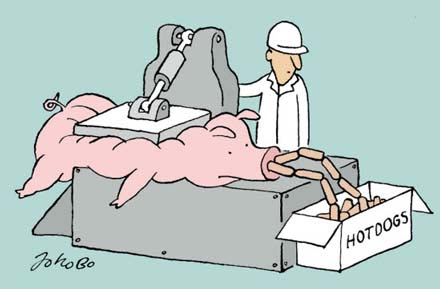
Tell Me How the Sausage is Made

My first year teaching (aka last year), I received the advice to only create a few, simple, easy-to-understand classroom rules. The four rules I created included cell phone use (none), touching each other (please don't), and being respectful (what does that even mean?). Students also created class norms over the course of several classes for each group, but the rules were mine. Midway through the year, trying to get a student to stop wandering around my classroom and/or yelling to her friends across the class, she said something along the lines of, "Mr. KV, you have so many confusing rules and you don't write them down!" 

In the chapter "The Silenced Dialogue," Lisa Delpit notes that oftentimes white liberal educators create a white supremacist culture of unspoken expectations and rules that mirror the SCWAAMP power structure we've discussed in class. Delpit argues that students should be explicitly taught that structure and codes of power in the classroom, and to do so teachers need to be in consultation with adults who share their students'  culture. Delpit follows a theme of this "culture of power" that exists within classrooms, reflects our current society, and is often blindly perpetuated by overly defensive do-gooders. 

Early in the text,  Delpit provides several examples to demonstrate how unhelpful ignoring unspoken rules or expectations is for someone who does not comprehend how they are failing to meet that standard. Her example of the interview hints or asking questions that are intended as directions illustrate how accepted language can derail someone. Classroom rules often perpetuate this issue, for example in the image to the left. What is "showing respect" in Rule 3? What are safe choices, or active participation and cooperation? Will a student be rewarded if they excitedly yell out their opinion during storytime? Or will they be confused on why their active participation was not wanted? These are the indirect ways of telling students that there is a code of conduct that they are expected to follow. This code will be simple and easy for some students to follow, and meanwhile others will be continually confused why they are failing to meet opaque expectations. 


To borrow an idiom, Delpit's chapter seemed to me like a detailed argument on teaching how the sausage is made. She notes several students' frustration with indirect methods of instruction, as they vent that the teacher did not do anything to actually teach them. She references a prevailing worry that there are secrets being kept and deliberately not shared with students who are outside of the existing power structures, when in fact it's more likely that teachers are designing lessons based on reinforcing or reviewing information that they assume students already possess. In the middle of the text, Delpit notes that the strongest teaching methods that she sees are explicit direct instruction, followed by student-centered conferencing. 

And yet, there still lies the question of how. I struggle with this question, because of the balance that must exist. I agree with the point that ignoring these power dynamics perpetuates the status quo, as it mirrors work that I've done earlier regarding aspects of white supremacist work culture. However, with a classroom there is a delicate balance that I'm not completely confident in navigating. It seems like a thin line between trying to incorporate instruction and committing the type of cultural genocide that Delpit references early in the text. However, luckily for me, she provides an answer. 

The last key point that Delpit notes in the idea of consultation. She notes how liberal academic spaces silence people who can speak from direct experience, and how ostracized the community can be from schools. It's only by working within and with that community that teachers will be able to navigate these questions. Because not all lessons are as easy as realizing you need to give direct instructions on 7th graders. Luckily for my students, that one was a quick one for me. 

Tuesday, February 24, 2026

Tell Me What You Can Do, Not What You Can't

 Bill Belichick had a philosophy when it came to drafting or recruiting players. He would look at several key metrics that he thought were essentially important, and then would ask his scouts to tell him only good things about that player. He would then make decisions based on how different players' skills would make them valuable contributors to the team, rather than trying to measure or rank different players against each other. And while he was absolutely atrocious at selecting wide receivers, Belichick routinely found undervalued contributing players by focusing on their talents rather than their flaws. 

In this week's reading, Shannon Renkly and Katherine Bertolini argue that by reorienting to an asset-focused model, schools could better serve all of their purposes by proactively focusing on student growth, community building, and staff development. Renkly and Bertolini note that an asset-based model necessitates a community-based approach, meaning that it must occur for all members of a school community. This approach also necessitates involving a larger community of parents, guardians, siblings, and the neighborhood to support student learning. 

I teach 7th-grade Social Studies at Villa Nova Middle School in Woonsocket, and the article's argument that middle school years are essential years for this approach resonates strongly with me. American schools create a very harsh transition for students from elementary school to middle school, and one of the most difficult things I see is how negatively many of my students view school. They view it as a trap, a forced requirement, a place where they do not see any positive associations. My warm-up question when we return will be "What's one fun thing you did with all of this snow?" and I already know that many students will just write "Not going to school" and when pressed for more will write "sleeping." Despite their hatred of school, they are not finding creative employment outside of it. School is still largely the place where young people find (or don't find) the social, creative and intellectual interests that will propel their lives. 


In noting the impact of this paradigm shift, Renkly and Bertolini bemoan the overly reactive nature of schools and how a deficit-focused mentality focuses on "fixing" a problem. In my experience, even when schools offer positive support, they come with a perogative to "fix" aspects of the student so that we can start offering that help to the next failure. I have an emerging bilingual student from Brazil who writes entire paragraphs and pages in English to my warm-up prompts and Exit Tickets. She despises her reading support class where she must progress through an online curriculum, answering multiple-choice, matching, and one-word answer questions until her ACCESS scores improve. Imagine her reaction if instead she was told that her brilliant effort and creativity had earned her a spot in a writing workshop. Imagine how much she would improve if she actually had the chance to work 1:1 with a teacher on her writing, instead of getting feedback from her Social Studies teacher on one piece a week. It wouldn't require any staffing changes, it would just require us to stop thinking that learning and creative interest are unrelated. 


In the middle of the piece, Renkly and Bertolini note that asset-based models are also better at building community. By focusing on the strengths and growth of students we can better engage caregivers, connect students to opportunities, and bring in the external community to the school day. It provides a vision of what better schooling can be. It makes me think of the scene from the "Precious Knowledge" documentary where students watched lowriders bounce on hydraulic suspensions. Every student could have seen that moment differently. Some could have thought about wanting to be mechanics, some could have thought of future rap careers, some could have been excited to talk to their neighbors about their cars; the positive ripples are endless. That is the potential for an asset-based model in education. 

Tuesday, February 17, 2026

The Broken-Down Car: American Education

Pre-Blog Rant:

Working in policy before becoming a full-time teacher, I never fully understood the root of the anger that many teachers carried into policy conversations. Then I became a teacher and realized I have to constantly read things like Khan finishing a great comparison on page 3 (or 63) with, “As with our eating habits, so with our teaching habits.”


Policy-makers, -writers, -thinkers, etc place an abhorrent amount of both passive and active blame on teachers. But here’s the thing, IT’S NOT TEACHERS MAKING THESE DECISIONS!! Our teaching habits are not the problem. I do not know a single teacher who thinks high-stakes testing or mandated online curricula are good for our students. I do not know a single teacher who would advocate for the schedule that students experience. We are not asked to design, we are told to execute. Teachers are drivers who are actively soldering and taping pieces of a car together as it races down the road, listening to the engineers of this monstrosity look on and say, “Wow, they’re really ruining that car. We should take away creative control of driving decisions.” 


The Force of Inertia: 

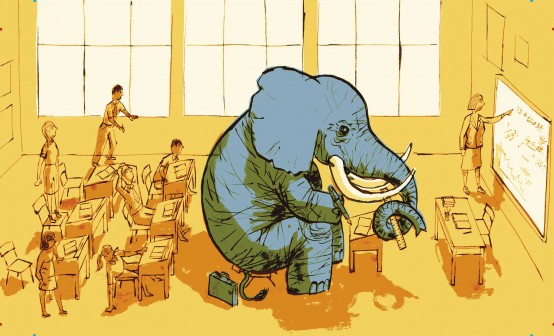
In this week’s reading, Khan argues that the American education system is built upon a self-sustaining foundation of training young people to be obedient, regimented and function as chattel for American capitalism. Rather than the more lofty philosophies of an educated and engaged American populace sustaining our democracy and paving the way for a brighter future, our schools are built on constant interruptions, rigid work requirements, and tracking student “growth” as if mental acuity could be measured with a number. In 120 years, this system has remained largely unchanged due to the fact that we have built our society around the structure it provides. 


I was on a committee several years ago and had the opportunity to hear Paul Reville explain the educational inertia that Khan describes by saying the term “education system” is part of the problem. Reville noted that we do not have one system. Rather, public education is used for three distinct systems: 

  1. Education System: teaching children things. 

  2. Childcare System: providing free childcare and child-rearing services for parents

  3. Employment System: giving jobs to a large number of teachers, administrators, custodians, social workers, and a truly staggering number of highly-paid people working in the central administration of urban public schools who neither live nor send their children to school in that district. 


Reville noted that of these three purposes, the only one that’s actually working is the employment system. Any parent would tell you that childcare ending at 2:30pm does not fit most job schedules, and any teacher would tell you that they cannot come close to replacing the child-rearing services that parents provide. Regarding education, Khan notes that the Prussian model of regimentation and order above initiative does not produce the best education results. Even considering the severe limitations of testing, the numbers present a clear picture that our educational system is not meeting its own desired metrics. And yet, this system limps on. It sustains itself not because we have nothing better, but rather because the repercussions of unsuccessful or even awkward change are too politically volatile for anyone to embrace. 


Khan’s example of the New York school testing overhaul encapsulates that political problem and what happens if the truth that change reveals (scores are artificially high) is something people don’t like (you blame the change). However, I was frustrated with how Khan described the political conversation around this issue, because while I agree that inertia is a problem, I also think that there are strong, political forces that are actively working to support this system. Khan rather flippantly separated politics into the “left” and “right” and then said that conservatives want more choice and liberals do not like corporations. The political reality is so much more complicated, which I think is exemplified by the example of Charter School Networks. 


Charter School Networks, the Perfection of the Prussian Model: 

In my opinion, charter school networks have been the most important educational force in the past several decades. Charter schools began in the 1990s, and the expansion of these types of schools was presented as an effort in educational reform, change or improvement. However, Charter School Networks are school franchises (think Lowes, Home Depot, or Hobby Lobby) and have spearheaded the rapid proliferation of charter schools across urban districts by banking their credibility on the value system of a traditional Prussian model of education.


Khan says that conventional schools place a great emphasis on test results (page 16 or 93), but this has really been exacerbated by direct educational competition. Charter School Networks expand in cities by touting their testing prowess, comparing the test results of their scholars with existing public schools to show that they are better. They also enjoy touting discipline statistics, demonstrating that their schools are safe and orderly places. As public schools (just do not look carefully at parental requirements or Special Education populations) they recieve public funding and serve as a continual 1:1 comparison in how public schools are failing these accepted Prussian standards.


Charter School Networks are immensely politically powerful. They combine the interests and support of massively wealthy Americans (ex. Betsy DeVos) with the political support of city populations who want a school today to send their children. They have used this political capital to solidify the dominance of testing as an educational measuring stick, they target urban school districts as areas that need expertise and guidance from outside of the existing community, they weaken existing public school districts, and they have paved the way for the expansion of school choice voucher programs. It is hard for me to consider systems of exclusion in education without thinking of this political force.


So what? 

From my perspective, this is where we currently sit in education. Regimentation is more the rule than ever, as any school in CSI status can attest. Efforts to reform education are difficult, and too often are now based in online or AI-generated curriculum. However, I do think there is actually an easy path forward that we refuse to consider.


In the committee I referenced earlier, we learned about many schools that radically improved through shared-governance models. This model is different in many places, but the concept boils down to something simple. Share power across all levels of an educational community, rather than just narrowly confining who makes the decisions. Essentially, create a true "Community School." Allow the students, parents and teachers to really contribute to decision-making, reduce the amount of external requirements that are being placed on all schools, and give the school funding necessary to change or add what it needs. We are terrified of doing this in schools that are not predominantly white, another lovely example of systemic racism in America, but giving a local community power over their school will result in changes that make sense for education, rather than Reville's other two systems.


OR nearly every time we invest more money in a school or district, things improve. So we could just spend WAY more money. That would probably work really well too.


Tuesday, February 10, 2026

Color Insight

In "Colorblindness is the New Racism," Margalynne Armstrong and Stephanie Wildman argue that by departing from the privileged perspective of pretending to be "colorblind" and utilizing the framework and vocabulary of color insight, people will be able to engage in the deeper converations necessary to understand the function of race and privilege in the larger world. Their arguments are buttressed and supported by Mellody Hobson, as she builds on their ideas to discuss the incredible impact that can occur when these conversations happen. Whether finding a vaccine for smallpox or building the worldwide leader in sports, I thought Hobson's examples helped transition this topic to the opportunity cost of failing to find a space of color insight.


At the beginning of the text, Armstrong and Wildman emphasize the failures of a colorblind mindset. They state that failing to name and examine whiteness, whether in a classroom or a courtroom, obscures the operation of privilege. The quote that stands out to me is “The dominant norm of colorblindness obscures and maintains that status quo of white privilege.” They argue that the solution to this problem would be to teach how to analyze privilege in different spaces. 


Building on their rebuttal of colorblindness, Armstrong and Wildman describe how color insight can build a vocabulary for teaching across racial lines. While their examples infer an older group of students, Hobson’s example stays with me. She notes that as a four year old her mother was determined to present the world as it is, baring the dark truths of neighborhood bias, Santa Claus, and the impact that racial bias can have on a life. 


Both the text and video note that being informed about systemic inequity is necessary, productive and realistic. Hobson claims that it left her thinking that she could do anything. She even notes that it created a lifelong work ethic. I wonder if this would be true of many four-year-olds, or whether Hobson's clearly dedicated and encouraging mother was a necessary support as she navigated the grimmer realities of the world. It kept me thinking about institutional conditions that need to exist in support of this educational practice.


In the examples of educational techniques to foster color insight towards the end of the text, I found myself thinking a great deal about Melody Hobson's points regarding diverse environments being the strongest environments. Think about the color line activity in a wealthy Rhode Island classroom. How isolating would it be to be one or two students in that classroom who consistently circle "below the line" attributes? Would you have created a hostile environment for a small number of students for the benefit of their privileged counterparts? I think you could make the argument that these types of educational practices need to be incorporated only after the school has really considered how this is a holistic practice, rather than isolated lessons.  


One final example that Hobson shared stayed with me. She noted that she was going to counter a stereotype about race by sharing how much she loves swimming. And yet, even though it was to share a story about perseverance, I couldn't stop fixating on the casual dismissal of a systemic issue. In Rhode Island, we lose children every year when they drown in Narragansett Bay and the Atlantic Ocean. And they drown because they are never taught to swim, which stems from that negative stereotype. 
 So in conclusion, I want to plug Ray Rickman and Stages of Freedom. Ray teaches free swim lessons to scores of children in Providence every year, because at some point, waiting for systemic change doesn't work. 

Saturday, January 31, 2026

Two White, Middle Class, Heterosexual Males Reflect on Privilege

Week 2: Alan Johnson's "Power, Privilege and Difference"  

_____ Argues that . . . 

In this reading, Alan Johnson argues that culturally constructed dynamics of power and privilege define our society, the opportunities afforded to different people, and the daily lived realities of our population. 

Three Talking Points: 

  1.  Early in Chapter 1, Johnson discusses the importance of language and not capitulating to the people who work to twist these terms to reflect a politicized, defensive, debate-me-bro mentality. Johnson writes, ". . . if we dispense with the words we make it impossible to talk about what's really going on and what it has to do with us." (Chapter 1, page 2) It immediately makes me think of this past year, where words like inequity, diversity, privilege, segregation, discrimination, and hundreds more have literally been banned by our government. 
  2. In Chapter 3, James Baldwin's commentary on whiteness is used to articulate the point that race and the privileges that it affords are cultural and social constructs, and it makes me wonder about how this reality manifests itself in school settings, both teacher-to-student and peer-to-peer. 
  3. At the end of this reading, Johnson makes the point that addressing the issues of power and privilege is hindered by the disconnect between being privileged and feeling privileged. It did bring to mind a circumstance in my school, where a student who faced suspension screamed in the front office, "The white kids never got in trouble in this school!!!" He was then faced by a parent who needed to explain to him that he was, in fact, white. It is fascinating to see this disconnect arising in a 12-year-old. 

Making Connections

All our scenario questions in the activity "Where Do You Stand" are questions of power and privilege. Should a teacher have students dress up in costumes of a community that has faced genocide and centuries of oppression? Is a father-daughter dance appropriate? Should we infer on a onesie that this baby will have lots of sex when they grow up?  All of these are questions of power and privilege. 


Final Reflection: My Teach Out

Final Reflection:  Nearly every week in this course, my classmates and I have challenged ourselves to think critically about our roles in ed...