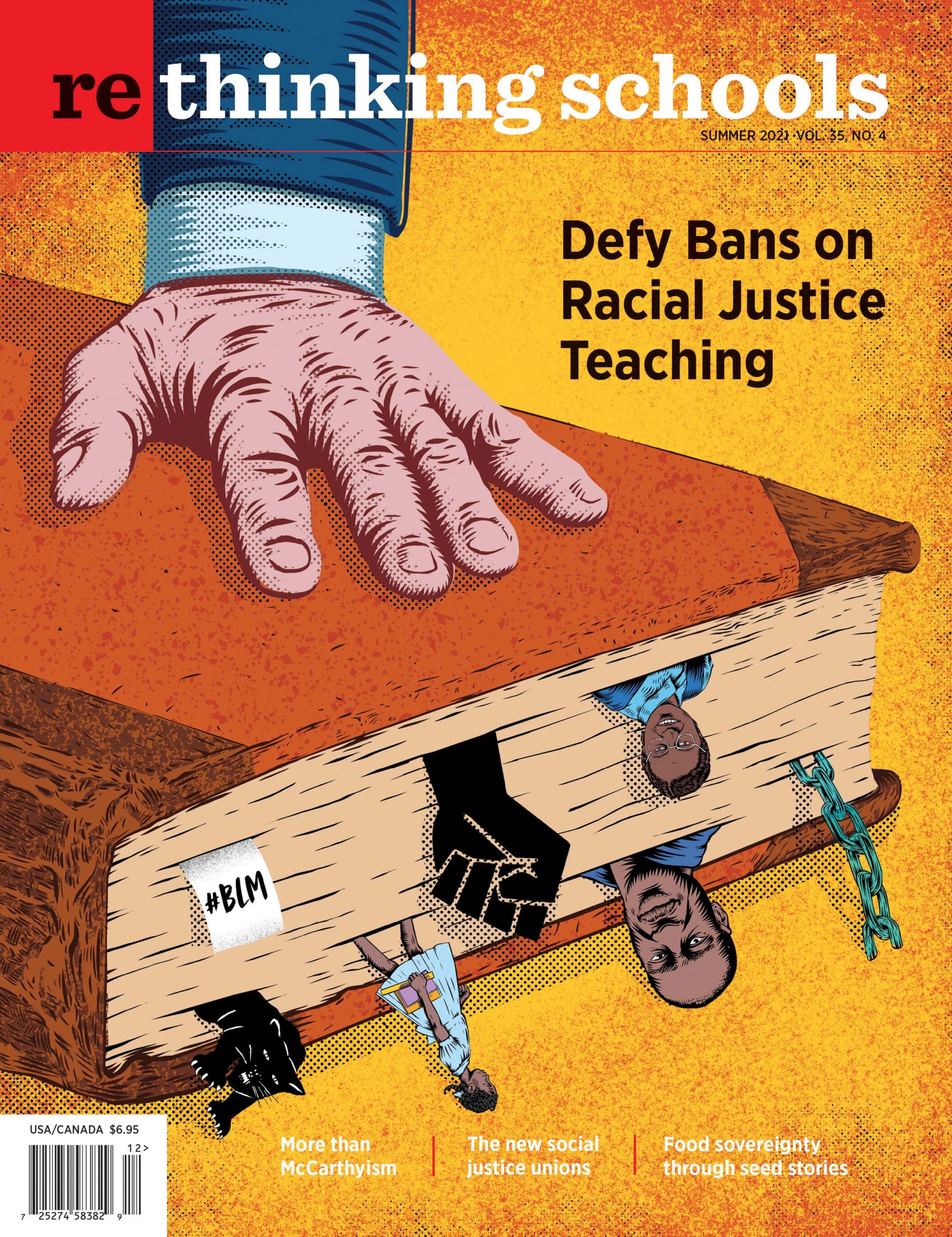
Reading over some of your [my classmates'] blogs this semester, I have occasionally grown concerned by my often myopic focus on the larger policy conversation around education. But as Popeye would say, I yam what I yam, and so I could not help but be drawn in by the Summer 2021 issue, Defy Bans on Racial Justice Teaching.
My oldest sister worked in one of the largest educational research firms in the country for nearly a decade. At the beginning of 2025, she had several projects focused on integration in urban schools, equitable access to afterschool programs, and just generalized work examining how the American education system repeatedly fails most students who are not wealthy and white. Within two months, her entire portfolio of projects was decimated. The Department of Education pulled over $90 million from the organization, and nearly all their projects were shuttered.
This issue was released four years before the second Trump administration came into power. However, many of the articles feel like they could be issued today. The opening editorial shares a rallying cry for post-Civil War southern education programs, "The Alphabet is Abolitionist." Knowledge is power. Education is powerful. This is why our educational programs have been under relentless attack from waves of legislation that have been passed in over half the states in the USA. From eliminating funding to trying to police the words we say in our classrooms, there are political forces in this country who are desperately trying to return our schools to that Prussian dream of obedience and efficiency.
I think it's incredibly important to pay close attention to this legislation, depressing as it is, because it shows the fear of the regressive and racist forces in our country. Centered in so much horrible language is this, "The United States and _[Insert State Name Here]__ are not fundamentally, institutionally, or systemically racist or sexist." I would argue that this statement is really at the core of our current political debate.
How Does This Work? The McCarthyism Example
In "More than McCarthyism," Ursula Rolfe-Rocca used the example of how an era of activism from 1945 to 1960 is remembered in textbooks. The "Second Red Scare" centers one person in the narrative of how we teach this period, he even gets in the title of my section here. Rolfe-Rocca unpacks how centering Joseph McCarthy in this historical narrative erases the victims, consequences, and real motivations behind the vicious crackdowns of this era.
:max_bytes(150000):strip_icc()/HUAC-Gary-Cooper-2400-3x2gty-59f8c0579abed500107c349d.jpg)
Rolfe-Rocca notes that even the term first and second Red Scares diminishes the reality. Essentially, from the conclusion of World War I through to the Civil Rights Movement, the American government used various committees and intelligence agencies to illegally arrest, harass, and spark violence against nearly any organization that was working for some form of equitable societal improvement. Rolfe-Rocca looked over five textbooks to see how this event was covered.
As I noted before, Rolfe-Rocca notes that centering McCarthy in this history is hugely problematic. McCarthy, a genuinely evil person, is afforded line after line of details, anecdotes, and analysis of his motivation. The victims of these attacks and arrests are rarely recognized, named, or segregated to inserts or additional readings. It also creates a very convenient narrative that McCarthyism ends in triumph, as Congress condemns him in 1954 for conduct unbecoming to the Senate.
A larger evil that Rolfe-Rocca describes is that the books' focus on McCarthy obfuscates the actual political fight that was occurring. The books give a cursory description of communism and note that McCarthy's investigations went far beyond economic beliefs, but then move on. They do not share with students how the people targeted were those trying to address the systemic inequity at the heart of American society. They do not connect the ideas of communism with the idea of protest.

Ursula Rolfe-Rocca ends by describing how she has altered the unit. Instead of teaching about McCarthy, she teaches about 27 different people who were attacked. They are men and women, immigrants and native-born, young and old, racially diverse, in and out of government, rich and middle class and poor, Queer and straight. She then uses their stories and experiences to teach this history.
Connecting the Two Threads:
Something terrifying continues to happen in the Trump Era of America. Similar to McCarthy, we allow one person to occupy all the space in our stories. After Elon Musk left his short-term position as the leader of the Department of Government Efficiency (DOGE), the press really stopped covering the impact of these cuts. We stopped talking about the funding that was taken away, the programs that were shuttered, the impact of erasing these funds so rapidly and callously. Instead, we have some conveniently attention-grabbing figures to focus our attention on.
As lawsuits proceed against the Department of Government Efficiency (the famous Must-led DOGE), a video clip of a deposition came to light that rapidly became viral. The video shows a former DOGE staffer who personally shuttered millions of dollars in programs. He discusses using AI bots to comb through grants, struggles to define any terms related to diversity, equity, and inclusion, and explains that a documentary about female Holocaust survivors is discriminatory because it's only about women. People enjoyed this video because it shows discomfort and no small amount of stupidity. But also think about the impact that giving THIS person so much power to erase work he clearly has no comprehension of.
What is happening in America today deserves more attention. We again are at a point in history where people trying to address the systemic inequity at the root of society are being attacked, marginalized, and silenced. Let's hope that in 50 years when this period of history is covered, we don't just have to read about Donald Trump.


Hi Tom, your post is enlightening. I do recall hearing about the A.I. bots that would "read" through grants and start banning or cutting things that were deemed against the current Administration's agenda, including gutting anything with the terms D.E.I., as well as the individual words that they represent: Diversity, Equity, and Inclusion. It is scary that it seems to be all about Trump. So much so that he is trying to have his name on buildings that have nothing to do with him, including the John F. Kennedy Center for the Performing Arts. What a narcissist.
ReplyDeleteHi Tom, I really liked when you said "Knowledge is power. Education is powerful." I agree. Trump continues to try to take away the country's knowledge so then we aren't able to question him and really see how horrific it is to be in this country. It is crazy to think about history books being written about COVID and both of Trump's presidencies and all of the hurt that comes along with it.
ReplyDeleteI really appreciated how you connected the history of McCarthyism to what’s happening in education today. The way you explained how focusing on one figure erases the broader struggle really stood out, and it makes me think about how often history is simplified instead of showing the full complexity.
ReplyDeleteIt was also really unfortunate that your sister’s research opportunity was taken away. Losing $90 million in funding and having those projects shut down shows just how much real work to address equity can be disrupted by political forces. It makes the issue feel very immediate and personal, not just theoretical.
I also liked your point about centering the stories of the people affected rather than just the prominent figure. It reminds us that teaching history well means amplifying the voices of those directly impacted.
Hi Tom, Thank you for always bringing the policies and politics to your posts because I am not nearly as enlightened as you are in that field of study. It seems like what you are stating should be coming out of this horrible movie, but no, it's our reality. The idea that one person occupies such a large platform is the exact opposite of what a democracy is supposed to be. As it has been said countless times, history repeats itself and we can see that coming full circle in this day and age. This leads me to think what can we do as educators? What impact can we bring to kids to show them the ugly truths without imposing our beliefs? I think this is a genuine conversation and one I would love to have with the History teacher on my team.
ReplyDelete